The Architecture Behind Reliable Ecommerce AI Agents
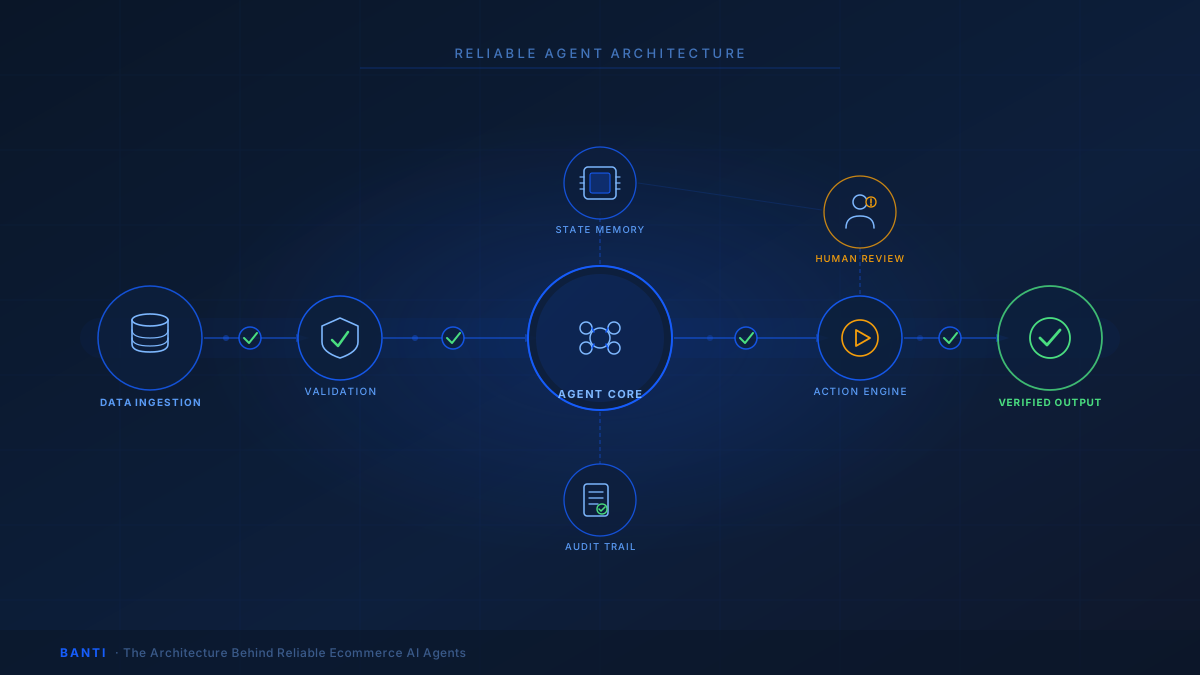
Demos make AI agents look easy. You type a query, the agent reasons through it, calls a few tools, and returns a clean result. In a controlled environment, with curated inputs and known data shapes, this works beautifully.
Production is different. Production means your 3PL's API times out on Black Friday. It means a customer submits a return form with a completely different order number than the one they're referencing. It means Shopify's webhook fires twice for the same order. It means an inventory sync fails silently at 2am and nobody notices until a customer gets two shipments of the same item.
Building reliable AI agents for ecommerce isn't really an AI problem. It's an engineering problem — and understanding the difference is what separates agents that work from agents that create more work.
Why Reliability Is Hard in Ecommerce
Ecommerce operations are particularly demanding environments for AI agents for a few specific reasons:
- The data is messy and inconsistent. Your customers use different name formats across channels. Your SKU conventions evolved organically over three years and have multiple schemas in your database. Your 3PL uses different status codes than your Shopify store. Any agent operating across your stack has to handle this inconsistency gracefully — not fail when it encounters it.
- The stakes are real and immediate. A wrong action in ecommerce — refunding the wrong order, canceling the wrong shipment, approving a chargeback that should have been contested — has real financial consequences. Unlike agents operating in a CRM or a doc workspace, ecommerce agents are often touching money, inventory, and customer relationships in ways that can't always be easily undone.
- The systems are fragile and asynchronous. Third-party APIs go down. Webhooks arrive out of order. Stripe and Shopify have different timing for when a payment is "confirmed" versus when it's reflected in payout data. Any agent that assumes reliable, synchronous data from external systems is going to have a bad time.
The Five Pillars of Reliable Agent Architecture
1. Data Validation Before Reasoning
The most common mistake we see in ecommerce AI implementations is passing raw data directly to an LLM for reasoning without validating it first. Raw ecommerce data has all kinds of noise: null values where values are expected, unexpected data types, encoding issues, duplicate records, and stale cached state.
Reliable agents don't reason about raw data. They reason about validated, normalized data. Before an agent makes any decision, the inputs it's working with should be checked for completeness, consistency, and plausibility. This validation layer doesn't need to be complex — but it does need to exist.
2. Explicit State Management
One of the most common failure modes we've seen is agents that treat every interaction as stateless. An agent gets a request, fetches current data, makes a decision, executes an action, and moves on. What it doesn't do is track what it already decided for a related event 20 minutes ago — or what state the system was in before it acted.
For ecommerce, state matters enormously. A chargeback dispute agent needs to know whether its previous attempt to contact the customer succeeded or failed before deciding what to do next. A fulfillment agent needs to know whether it already rerouted an order before deciding to reroute it again. Without persistent state management, you get duplicate actions, conflicting decisions, and confused customers.
3. Bounded Action Sets
The most reliable agents are not the ones that can do the most things. They're the ones that know exactly what they're allowed to do and will not go beyond it.
At Banti, each agent operates with an explicit action set — a finite list of operations it can perform, with defined preconditions, side effects, and rollback capabilities. An agent handling refunds can issue refunds up to a certain threshold, flag higher amounts for review, and notify customers — and that's it. It cannot cancel orders, modify addresses, or override fraud flags, even if those actions would theoretically be relevant to the situation.
Bounded agents fail in predictable, containable ways. Unbounded agents fail in ways that propagate.
4. Full Observability
You cannot debug what you cannot see. For AI agents operating in production, observability isn't optional — it's a prerequisite for trust.
Every agent action should produce a structured log: what input was provided, what reasoning was applied, what action was taken, what the outcome was, and what state was left. This isn't just for debugging. It's for compliance, for support resolution, for fraud investigation, and for the operators who need to understand why a particular decision was made.
One thing we've found especially useful: structuring agent logs so that a human can read them without any technical knowledge. "Customer support agent issued a refund of $24.99 for order #8214 because the customer reported a damaged item and the order was within the 30-day return window" is more useful than a JSON blob of tool calls and token outputs.
5. Graceful Escalation
Every agent needs to know what it doesn't know. When an agent encounters a situation that falls outside its normal parameters — an ambiguous customer complaint, a payment dispute with unusual circumstances, an inventory situation that violates expected patterns — it should not guess. It should escalate.
Escalation paths need to be as carefully designed as the action sets themselves. What triggers escalation? Who receives it? How quickly? With what context? A good escalation is not a failure; it's an agent correctly recognizing the limits of its reliable judgment and routing to a human who can handle it.
The Reliability Dividend
When you get this architecture right, something important happens: your team starts trusting the agents.
This sounds obvious, but it's actually the critical unlock. The operations teams we work with initially treat agent outputs as "suggestions to review." Over time, as they observe that agents consistently apply the right rules, handle edge cases appropriately, and escalate when they should, they start treating agent outputs as decisions that are already made — and review only the escalations.
That's when the productivity gains become real. Not when the agent can handle 100% of cases autonomously, but when the team trusts it enough to treat its outputs as authoritative for the 80–90% of cases that fall within normal parameters — and knows that the rest will come to them correctly flagged.
What This Means for How You Evaluate AI Agents
When you're evaluating AI agents for your ecommerce operation — whether you're building your own or working with a vendor — the questions that matter most are not "how smart is the AI?"
The questions that matter are:
- What happens when the API is down?
- What happens when the input data is malformed?
- What actions can the agent take, and which are explicitly outside its scope?
- Can I see exactly what the agent decided and why, for every action?
- When does the agent escalate, and how does that process work?
- What does a rollback look like if the agent makes a mistake?
If a vendor can't answer these questions clearly, the agent is not ready for production — regardless of how impressive the demo looked.
The Foundation That Enables Scale
Building reliable agents feels slower than building impressive agents. It requires thinking carefully about edge cases, designing escalation paths, investing in observability infrastructure, and sometimes saying "this agent won't do that" even when technically it could.
But reliable agents are the only agents that scale. The brands that will successfully automate their operations aren't the ones that deploy the most capable AI. They're the ones that deploy AI they can trust — and build the architectural foundation that makes that trust warranted.
At Banti, reliability isn't a feature we add on top of our agents. It's the constraint we design around from the start. Because in ecommerce, the cost of an unreliable agent isn't just technical debt — it's customer relationships, revenue, and the operational credibility of the team that deployed it.
Want to see how we approach agent reliability in practice? Book a walkthrough with our team.