AI Payment Infrastructure for Agents: What Ecommerce Operators Need to Prepare For
Most ecommerce operators are already used to new channels. First it was your storefront. Then marketplaces. Then social. Then affiliate, wholesale, retail media, and everything else.
Now there's a new channel showing up fast: AI agents that help customers discover, compare, and increasingly complete purchases.
This matters because the shift isn't just "another traffic source." It changes the payment and checkout infrastructure underneath your operation. And if you're an operator, that's the part worth paying attention to.
This Is Not Just About AI Shopping Assistants
A lot of people talk about agentic commerce like it's a UX trend.
"Customers will shop in chat." "AI will recommend products." "Search will change."
That's all true. But the operational question is bigger: how does a brand safely accept, verify, and fulfill a purchase when an AI agent is managing the buying flow?
That is a payments infrastructure question.
- Stripe now has dedicated agentic commerce docs and an agentic commerce suite, positioning this as a real integration path — not just a concept.
- Visa has also launched "Intelligent Commerce" initiatives aimed at enabling trusted agent-initiated payments on its network.
- PayPal is also building agentic commerce tooling and partnerships around AI-driven checkout flows.
This is moving from "interesting" to "operationally relevant."
What Changes for Ecommerce Operators (in Plain English)
Today, your checkout is mostly built around a human user clicking through: view product → add to cart → enter info → pay → confirm.
With AI agents, the flow gets more abstract. The buyer may still be in control — but the agent can handle parts of discovery, selection, and transaction execution. That means your systems need to handle a new kind of participant in the flow: not exactly a marketplace, not exactly a normal browser session, not exactly a human managing every step.
For operators, this creates a new set of questions:
- How do we know this purchase is legitimate?
- What payment credentials or tokens are being used and how are they passed?
- What does fraud screening look like when a bot is authorized by a real user?
- How do we preserve our checkout rules — limits, promos, shipping constraints?
- How do we keep a clean audit trail for support, finance, and reconciliation?
That's the real topic.
The Core Shift: From "Accepting Payments" to "Accepting Delegated Intent"
Traditional checkout verifies a person's payment action. Agentic checkout has to verify something more nuanced: a user delegated shopping and payment intent to an agent, within certain bounds.
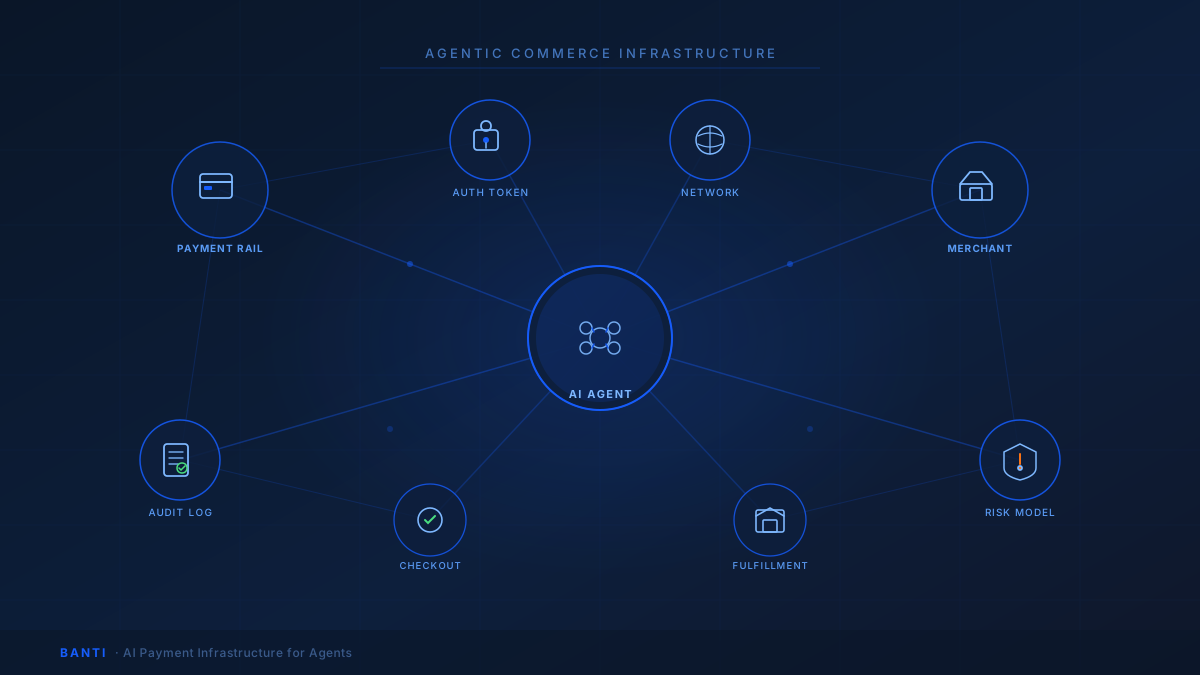
That's why the infrastructure conversation matters. You need systems that can support things like:
- Secure credential and token handoff
- Authorization boundaries — what an agent can and cannot do
- Stronger merchant-side verification signals
- Better event logging for disputes and support
- Risk models that can distinguish authorized automation from abuse
Stripe explicitly talks about secure payment credential passing and the need for merchants to accept agent-originated transactions in a trusted way. Visa's messaging similarly emphasizes trust, authentication, and payment signals for AI-driven transactions.
Agent payments aren't just a conversion feature. They are a control-surface change.
Why This Matters Operationally (Even Before Volume Is Huge)
A lot of brands will ignore this until "AI channels" become a meaningful percentage of revenue. That's understandable. But the ops risk starts earlier, because the same patterns will affect your stack before the volume looks material.
1. Checkout rules can get stress-tested faster
Agents are very good at finding edge cases: promo stacking behavior, quantity limits, shipping threshold quirks, bundle and variant inconsistencies, subscription discount loopholes. Even "good" agents can unintentionally surface logic problems your human users would never trigger.
2. Support gets harder without agent-aware event logs
When a customer says "my assistant placed this order but I didn't expect this variant," your team needs clean visibility into what was selected, what was authorized, what was paid, what rules were applied, and what happened at checkout. If that context is fragmented, your support and finance teams become the reconciliation layer — again.
3. Fraud and trust models need nuance
The future is not just "human good, bot bad." You're going to have malicious automation, benign scraping, authorized shopping agents, platform-mediated agents, and internal automations. Treating all automation the same will either hurt conversion or increase risk.
What "AI Payment Infrastructure Readiness" Actually Looks Like for a Brand
You do not need to rebuild your commerce stack for agents tomorrow. But you should start building toward an environment where agent-initiated purchases can be handled safely.
1. Tighten checkout guardrails first
Before you think "agent strategy," fix the basics that agents will expose: quantity caps, promo combinability rules, shipping method constraints, inventory reservation behavior, bundle and kit validation, refund and reorder edge cases. If your checkout logic has holes, agents will make them more visible.
2. Improve payment and order event observability
Make sure your team can reconstruct a transaction across systems without a forensic project. At minimum, you want reliable links between: checkout event, payment auth and capture, order creation, fulfillment event, refund and adjustment events, and support ticket timeline. This becomes much more important when the buying experience doesn't happen entirely inside your storefront UI.
3. Preserve merchant controls in any agent channel
As agentic commerce platforms mature, operators should push for integrations that preserve brand-approved checkout rules, shipping and return policies, upsell and offer logic, fraud and risk controls, and post-sale workflows. Stripe has publicly emphasized merchant control and brand-preserving checkout experiences in agentic commerce contexts. That's the right lens: don't outsource your operational controls just to gain a new channel.
4. Treat agentic commerce as a new channel in your ops playbook
Don't bury it under "AI experiments." Track it like a channel: conversion quality, AOV and margin quality, refund rate, support contact rate, dispute rate, fulfillment exception rate, policy edge-case frequency. That gives operators the data to decide what's actually working.
What This Means for the Next 12–24 Months
For most brands, the near-term future probably looks like this:
- AI agents drive more product discovery
- Some agent-assisted checkouts become normal
- Payment providers and networks handle more of the trust and token layer
- Merchants still own fulfillment, policies, margin, and operational outcomes
In other words: the payment rails are evolving, but the operational consequences still land on the operator. That's why ecommerce operators should care now — not because "AI shopping" is hype, but because when agent volume arrives, the brands that win will be the ones that already have clean checkout controls, strong transaction observability, better exception handling, and infrastructure that can support trusted automation without losing margin.
Final Thought
The big opportunity in agentic commerce is not just more conversion. It's higher-quality automation across the entire path from intent to payment to fulfillment. But that only works if the payment infrastructure and the operational infrastructure evolve together.
If they don't, AI agents won't reduce manual work. They'll just create a faster version of the same old reconciliation mess.
Want to see how Banti helps ecommerce operators build the operational foundation for what's coming? Book a walkthrough with our team.